Summary
(This content was created for a workshop that I gave to counsellors at the PCE Europe 2026 Symposium, it has been edited slightly for sharing on my website and a wider readership )
Living with a dog is wonderful….except when it isn’t. What can we do when things go wrong? Standard approaches have tended to involve consulting with various canine professionals, the focus being on ‘fixing the dog’. There is interesting evidence from a variety of disciplines suggesting that our dogs’ behaviours may be associated with our own mental and emotional health. Up until recently this has not been routinely considered when human-dog relationships struggle. The hypothesis in the workshop, and for future research, is; if people experiencing difficulties with their dogs are able to engage in person-centred counselling sessions the problems they experience with their dog will diminish and the opportunities for personal self-development and change will be much greater than current ‘dog-focussed’ approaches
LIVING WITH DOGS
When we live with a dog, we generally consider it a positive thing. They offer us companionship, unconditional love, and are great for our physical and mental health. However sometimes our dog doesn’t live up to our expectations. He or she might exhibit behaviours that we find difficult to deal. Perhaps we find the responsibility of living with a dog more challenging than we had expected. What happens then?
WHEN THINGS GO WRONG
Fix the Dog
The options available to us vary but they tend to focus, loosely speaking, on ‘fixing the dog’. Help might come from a dog trainer, a dog behaviourist, or perhaps our vet. Often we get resolution, but not always. Some people resign themselves to accepting and managing their problems. A subset of those people may have to give their dog up, either by rehoming or in some cases, sadly, by euthanasia.
What about the person?
There is an increasing understanding of how human-dog relationship can be a source of stress for the human. This is an important aspect that historically has not been getting as much attention as it deserves.
Studies have found that dog owners’ experience of guilt and work family conflict (WFC) with their dog is at similar levels to WFC reported in human family studies. Scientists have discovered that WFC and related guilt can be related to increases in depression and anxiety (Kogan et al., 2022).
A literature review on the effects of dog behavioural problems on owner well-being (Barcelos et al., 2023) found that dog behavioural problems may particularly reduce social interactions, and increase negative emotions of high arousal, such as stress and frustration, caregiver burden and symptoms of both depression and anxiety in their owners. A conclusion from this study suggested the need to offer social and psychological support for the owner in addition to practical behavioural support for the dog-human relationship.
A study by vets in the US (Kuntz et al., 2023) found that owners of dogs with behavioural problems (that were seeking care from a veterinary behaviour practices), demonstrated clinically meaningful caregiver burden. The study offered a number of solutions for veterinarians to consider including recognising when referral to an allied mental health professional may be of benefit.
Counselling
Counselling is a recognised treatment for anxiety and depression, difficult life events such as a bereavement, a relationship breakdown or work-related stress, to name a few. Pets in general play an important part in many of our lives. The recent research is confirming that our difficulties as a result of living with a dog are no different than any other problems we might experience, where counselling can help.
How do you feel about the dogs in your life?
SOMETHING ELSE TO CONSIDER
From a Dog Trainer
In 2011 Kevin Behan published “Your Dog is Your Mirror”. In it he explores three themes:
- we don’t know what we are feeling
- the behaviour of dogs can teach us about emotions and feelings
- the real reason for the dog in our life is emotional, and to reveal what instincts, thoughts and judgements prevent us from feeling what is at the very bottom of our heart
Below is a 2 minute clip from Kevin Behan’s Keynote speech at the 2018 Thermodynamics of Emotion Symposium
If you are inspired to hear more of Kevin’s talk, you can watch it at https://thermodynamicsofemotion.com along with many other great resources.
From a Psychologist
In his book ‘Client-Centred Therapy’ Carl Rogers (the founder of what is now termed Person-Centred Therapy) wrote
‘An aspect of therapy which is not sufficiently clear to many beginners is that the “problems” which are brought to therapy are not resolved directly, and that a frequent experience in therapy is the gradual realisation that the problem is not what is known in consciousness’.
It seems to me as I work with the ideas of Rogers and Behan that they are talking about something similar. We aren’t always best placed to know how we are feeling. We can be blocking our feelings from ourselves, but our dogs can feel what we can’t. In a supportive counselling relationship we can work through our problems and start to experience our life differently.
If the behaviour of the dogs that we share our lives with is mediated, to some degree, by our own emotional and mental health, then we can also look to work on ourselves. What our dogs do, and when they do it, is related to the emotional energy around them. Viewing problems that we experience with our dog in this way might reframe the difficulties we are experiencing as opportunities for our own personal development, aided and assisted by our dogs.
How are these ideas landing with you? Let me know in the comments section
From the Scientists
Scientific studies looking at the connection between humans and dogs are many and varied. In the section below I have shared some relevant discoveries.
Stress
Acute stress has been shown to be highly contagious among both humans and between individuals of other species. In 2019 researchers discovered for the first time that long-term stress levels was synchronised between humans and their dogs (Sundman et al., 2019). The original study involved dogs from the herding breed group (Shetland sheepdogs and border collies). A later study was completed to investigate features that could influence long-term stress levels in ancient dogs breeds (those that are genetically closer to wolves), and independent breeds (dogs that were specifically selected to work independently of their owner). There was no evidence of long-term stress synchronisation with the owners found in this later study, although the independent breeds’ stress levels were shown to correlate with certain human personality traits more than they did for the ancient breeds (Höglin et al., 2021)
Chemosignals
Chemosignals are scent-based chemical signals that are produced under different emotional states, like fear and happiness. They are produced by animals, including human animals. Researcher collected samples of chemosignals from humans when they were in fearful or happy states. When they presented individual samples to dogs, the dogs manifested the corresponding emotion. In other words, samples taken from humans in a happy state created a happy state in the dog and samples taken from humans in a fearful state created fear in the dog (Semin et al., 2019)
Heart Synchronisation
The Heartmath Institute (HMI) have been researching the intelligence of the heart for over 30 years. Heart coherence is when the heart, mind and emotions are aligned and working together harmoniously. When we are experiencing heart coherence, our stress and anxiety is reduced. HMI have been developing tools and techniques to help people achieve heart coherence.
HMI have also been researching how people are able to synchronise their heart coherence with people next to them and between people and other animals. Below is a clip from the HMI website on some of their research with pets. You can find the full video on the HMI website Exploring the Beneficial Bond Between People and Their Dogs
Unexplained Human and Animal Abilities
Rupert Sheldrake is a Biologist and author. He was Director of the Perrott-Warrick project for research on unexplained human and animal abilities, from 2005 to 2010, funded by Trinity College, Cambridge. His book, Dogs that Know when Their Owners are Coming Home (2013) describes some of his findings. A video of Jaytee from one of his experiments give an example of the phenomena he writes about.
From My Work
In my own work I have been keen to find evidence that dogs were responding to our emotions and have worked on a number of approaches:
- Reflections on my own thoughts, feelings and emotions when my dogs did something I didn’t like.
- Videoing and analysing conversations with my friends with my dogs in the room
- Videoing and analysing sessions with my therapist and each of my three dogs.
- Videoing listening sessions with volunteer clients that were experiencing difficulties with their dogs.
Personal Reflections
These are a couple of examples from my own experience. I give more examples like these in my blog, under the category Dogs Tuning Into Human Emotions
Archie and Driving in the Snow

Archie was a yellow Labrador retriever who I had lived with since he was 8 weeks old. We went everywhere together. He came to work with me in my van every day, lying on the passenger seat with his head on my lap. Travelling in the van was second nature to him. One day, when he was about 4 years old, we were driving home in a snow blizzard. The road we were travelling on was narrow, with a ravine drop at one side. The snow was settling on the road and it was very difficult driving conditions. I was incredibly nervous, driving about 20 miles an hour for the last 15 miles of the journey, before we reached home.
The next day the weather had cleared up and we started off to work but Archie did not want to get into the van. He was panting and drooling and shaking. I could tell he was really scared. It took many months before he could travel in that van again calmly. I hadn’t read about chemosignals at this point, but it was clear to me that sitting next to me in a state of fear the day before had rubbed off on him.
Discovering blocks to dog training
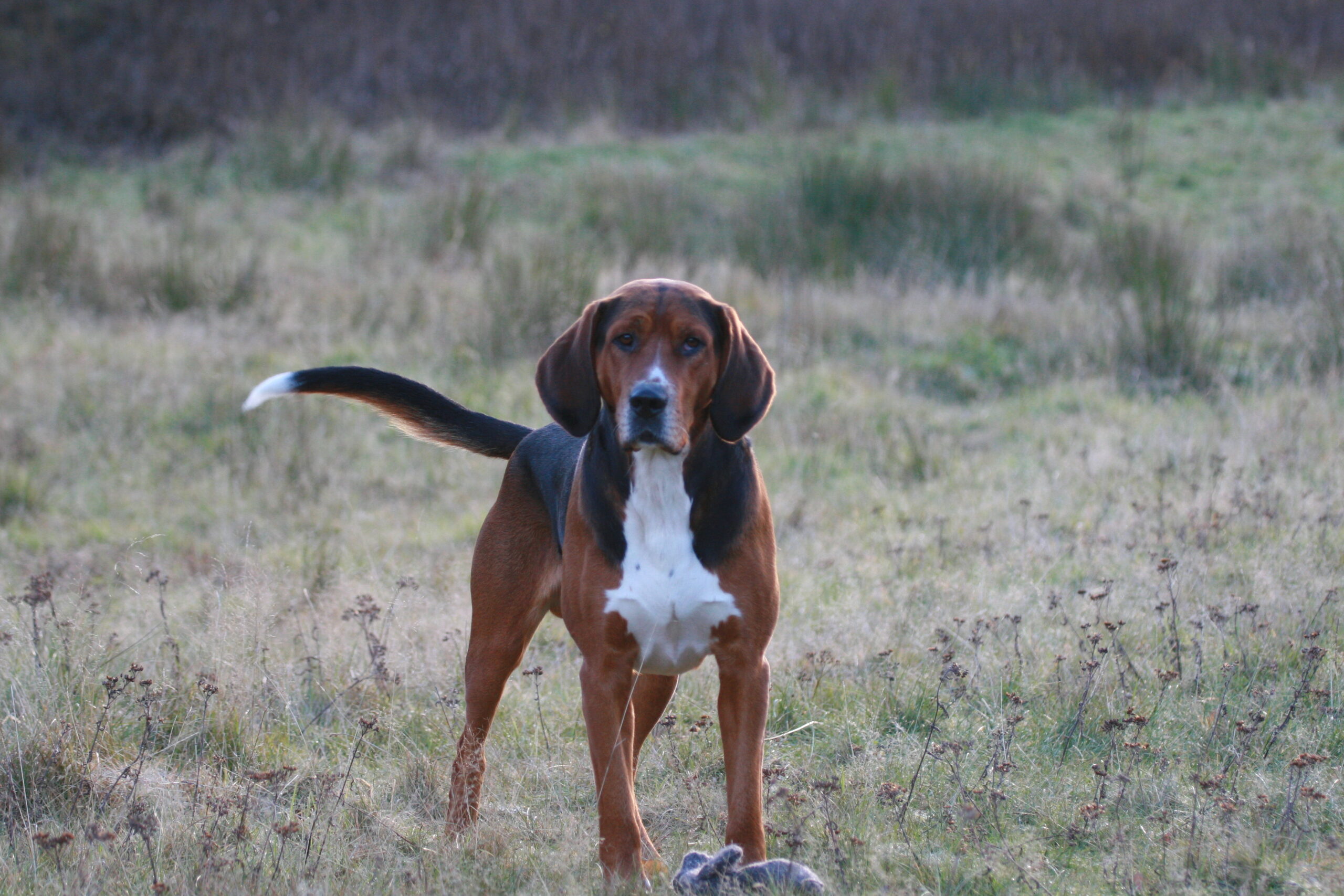
Jack was a Hamiltonstövare, a Swedish hunting breed, bred to hunt independently. He also had lived with me since he was 8 weeks old. When I first enquired about the breed, I was told that they had a strong hunting drive. I was advised not to let them off the lead, except in secure areas. Naively (in hindsight), I thought that was wrong. I wanted to train him to be safe off-lead, so he could enjoy the freedom I thought he should have.
For years I tried all sorts of training techniques. I started to use some of Kevin Behan’s techniques and things started to look more hopeful. I invited a dog behaviourist friend of mine over, to see how we were progressing. Claire watched us work. She was amazed.
Claire felt that this was the first time she has seen us interacting so well together. What came next surprised me. Instead of feeling elated, I felt sick and panicky. Simply put, I didn’t want the responsibility of him looking to me for the answers.
This was a shock, but it also made sense. I was the oldest of three siblings. Sometimes, when I was younger, my Mother has asked me to look after my brother and sister. I hadn’t always got it right and had some traumatic memories. My newly discovered ambivalence gave me a new perspective and a better understanding of myself.
Follow this link if you want to read about the process I follow for these personal reflections to try this at home
Grounded Research
This was a grounded research study, collecting data and conducting analysis to form a theory. I recruited 5 volunteers who were having a difficulty with their dog to try counselling sessions, accompanied by their dog; two clients had 1 session each, one client had 2 sessions, a third had 4 sessions and one had 57 sessions. Clients and data were anonymised.
The sessions were videoed. The layout of the room is shown in the diagram. The client and listener facing each other, the dog was free to move around the room during the session. The analysis included transcribing the session and noting the dog’s behaviour and any changes. Was the dog moving or stationery, standing, sitting or lying down? What position where they in the room? In what direction was their body aligned?
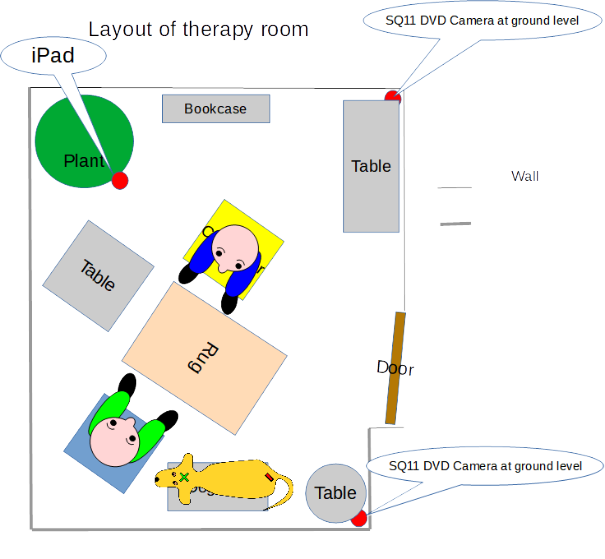
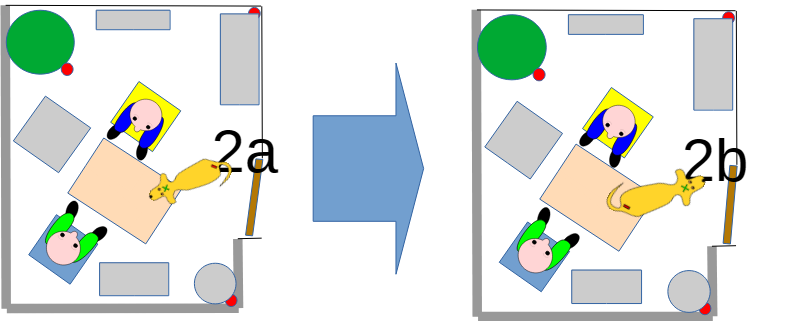
The different positions were coded and logged against the transcript of the session to interpret possible links between dog behaviour and the emotions and feelings in the room.
Some interpretations made from one session
This client explained that her dog’s behaviour had changed, starting two years ago, after the birth of her first child. He had started to steal things in the house and was eating random, inappropriate stuff when they were out on walks. She had consulted with dog trainers and behaviourists, who had advised her to muzzle him, which she was reluctant to do. I have highlighted three points of interest from one of our sessions.
- Early on the client mentioned that she had suffered severe post-natal depression. At the same moment that she mentioned this, her dog, who had settled down (position 2a), immediately jumped up and turned his body round before lying back down again (position 2b). It occurred to me that, by talking about this experience, the client had connected emotionally with this time in her life and that the dog had felt it as a shock in his body.
- There were two occasions when the dog took position 6, sitting or lying behind the listener. Both times the client was relating to feelings of guilt.

- A third interesting position was when the dog gave the listener attention, jumping up at them, in position 4a. This seemed to coincide with times when the client was wanting the session to end and I wondered if the dog was sensing, and responding to, the unwanted attention that was coming from the listener.

Conclusion from the study
These are, of course, just my interpretations, but the study showed some interesting behaviours that seem to confirm the emotional connectedness of some dogs to their owners. The volunteer participants that were involved in this study were fantastic. I am immensely grateful to them.
I want to stress that I’m not suggesting that clients attend sessions with their dogs as a means for the therapist to interpret what is going on for the owner through their dog’s behaviour. Personally I think that would be wholly inappropriate. This study was specifically collecting data on dogs behaviour around different human emotions. It’s also important for me to note that in these sessions there were two humans in the room and, I would suggest, the dog will be tuning into all the emotion around them. In other words, it isn’t all about the client, the therapist is also part of the emotional network. I highlight this in my work with my therapist and my own dogs which I describe in the following section.
PCT session with therapist and Joanne Frame, with Logan in attendance.
In the workshop at the symposium I shared some video footage from one of the sessions I recorded between myself, my therapist and one of my dogs. At the beginning of the clip my dog is getting agitated. I start to get upset as I describe a time from my childhood. Logan seems to settle down again when my tears start to flow. A few minutes later in the session Logan gets up and pushes his chest into the counsellor. We stop ‘the session’ and start to discuss what is going on in each of us, in an attempt to make some meaning of Logan’s behaviour.
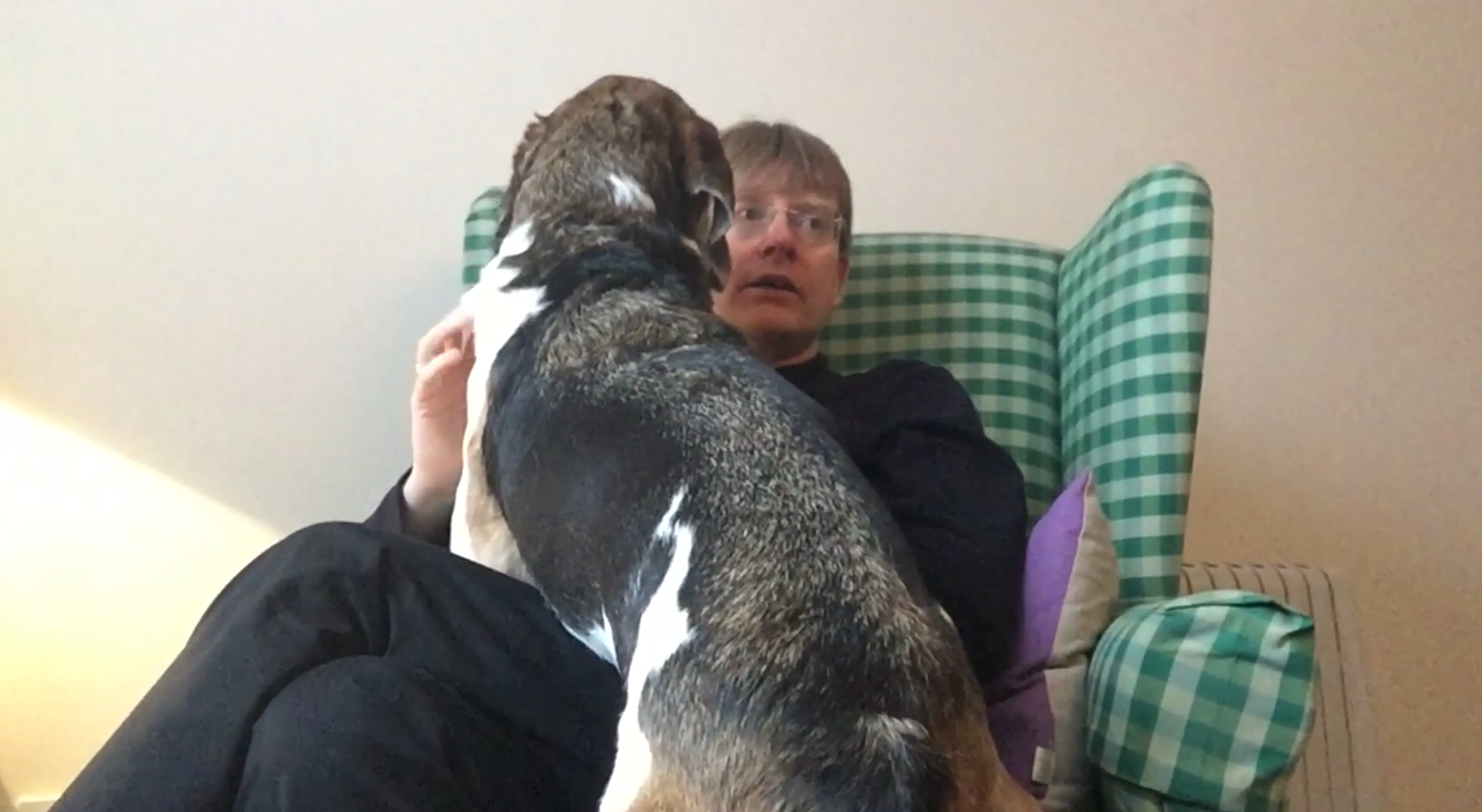
For confidentiality reasons I haven’t shared the original session video here but I have shared the interview between Terry, the therapist (an experienced Person-Centred counsellor) and myself, that we made for the Symposium. In it Terry shares his experience of that session and the interpretation he made of Logan’s behaviour. I hope you find it interesting.
CONCLUSION AND FURTHER RESEARCH
I have taken you through a collection of material to make the argument for why problems with our dogs might merit a closer focus on our own inner emotional landscape. I hope it has sparked some curiosity. My work over the last few years has convinced me that this approach can be just as important and useful as consulting with a canine professional when looking for help. Working on ourselves is not easy, it can be challenging. It can also reap rich rewards though, for you and your dog, and in how you live your life more widely.
I setting up a research project to look in more detail at how long term person-centred counselling can help people who are struggling with their dogs.
I would love to hear any thoughts you have on what you have read here. If you would like to get in touch to discuss any of the ideas, please do, either in the comments below or by email. I will reply.
If you are currently struggling with the relationship you have with your dog and would like to put yourself forward as a volunteer for my research, I would love to hear from you.
Take care